By Weddings and
Events by Amitesh
Wedding Planners
in Jaipur
Planning a wedding in India — especially a multi-day, multi-function celebration — is not a
one-person job. It is an orchestration. Hundreds of moving parts, dozens of vendors, hundreds of
guests, and one non-negotiable deadline: the wedding day itself. Whether you are a couple trying
to self-manage or a first-time coordinator stepping into this world, this checklist will become
your most trusted companion.
At Weddings and Events by Amitesh, one of the leading Wedding Planners
in Jaipur, we have
coordinated hundreds of weddings — from intimate 50-person celebrations to grand 2000-guest
affairs. This checklist is built from real experience, real crises averted, and real lessons
learned on the ground.
Unlike generic checklists you find online, this one is specifically designed for Indian weddings
— which means it accounts for Haldi, Mehendi, Sangeet, Baraat, the actual wedding ceremony, and
reception. It also covers things no one else talks about: hidden vendor red flags, day-of crisis
protocols, and how to handle family politics like a professional.
Let's begin.
First Things First: Understanding the Difference Between a Wedding Coordinator and a Wedding
Planner
This is one of the most misunderstood distinctions in the industry, and it matters enormously
when you are budgeting or hiring.
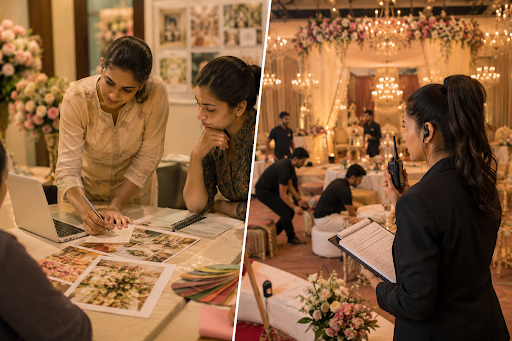
A wedding planner is involved from Day 1. They help you choose the venue, build the budget,
shortlist vendors, negotiate contracts, and design the entire event vision. They are strategic
partners throughout the entire planning journey.
A wedding coordinator typically steps in at the final weeks or on the wedding day itself. Their
job is to execute a plan that already exists — confirm vendors, manage timelines, handle
logistics, and make sure nothing falls through the cracks during the event.
Many couples make the mistake of hiring a coordinator and expecting the work of a planner, or
hiring a planner but treating them like a day-of manager. Understanding this distinction will
save you money, confusion, and disappointment.
At Weddings & Events by Amitesh, we offer both roles — and in many cases, we do both
simultaneously because Indian weddings genuinely demand it.
12 Months Before the Wedding: The Foundation Phase
This is where everything either starts strong or starts shaky. The decisions you make in this
phase will define the budget, the vibe, and the feasibility of everything that follows.
Budget Clarity
Before any vendor is booked or any venue is visited, sit down with both families and establish a
realistic, agreed-upon budget. Many wedding disasters begin not from vendor failures but from
misaligned financial expectations between families.
- Determine the total available budget across all contributing parties
- Divide the budget across functions: Mehendi, Haldi, Sangeet, Wedding, Reception
- Keep a 15-20% buffer for unexpected expenses — and trust us, there will always be unexpected
expenses
- Decide early who is paying for what (bride's side, groom's side, joint) to avoid last-minute
conflict
- Create a master spreadsheet with all planned expenses, deposits paid, and balance amounts
Guest List Architecture
The guest list drives almost every other decision — venue capacity, catering volume, invitation
quantities, seating arrangements, and transportation logistics.
- Create a master guest list with full names, contact numbers, and addresses
- Categorize guests by function (who is invited to which event)
- Separate outstation guests from local guests — outstation guests require accommodation
arrangements
- Mark VIP guests who need special attention, seating, or transportation
- Get consensus from both families before finalizing — additions after venue booking create
serious problems
Venue Research and Booking
Good venues in popular wedding cities like Jaipur get booked 12-18 months in advance, especially
for peak season (October to February). Do not wait.
- Shortlist venues based on capacity, location, ambience, and budget
- Check whether the venue allows outside catering or mandates in-house catering (major cost
implication)
- Confirm whether the venue has a Havan permit — many venues in urban areas do not allow open
fire rituals
- Verify parking capacity against your expected guest count
- Understand the noise curfew rules — many venues have a 10 PM or 11 PM limit
- Review cancellation and postponement policy in writing before signing
- Visit the venue at least twice: once during the day and once during an active event to see
how it actually functions
9 Months Before: Vendor Ecosystem Building
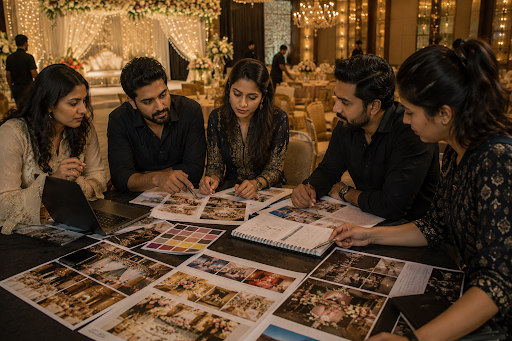
Think of your vendor team as a cast. Everyone has a role. Everyone needs to know their cue. And
like any cast, the quality of each individual matters — but so does how well they work together.
Photography and Videography
This is non-negotiable first-priority booking. Great photographers and cinematographers are
booked 9-12 months out in premium wedding markets.
- Review full wedding portfolios, not just highlight reels
- Confirm how many functions are covered and how many shooters will be present at each
- Clarify output deliverables: raw files, edited photos, album, drone footage, same-day edit
(SDE) reel
- Understand turnaround timelines for delivery of final edited content
- Get a detailed contract that specifies equipment backup policy (what happens if a camera
fails?)
Catering
Food is the most discussed topic at any Indian wedding — both during the event and for years
afterward. Choose your caterer with the same seriousness you choose your venue.
- Schedule a proper food tasting — never book based on reputation alone
- Discuss menu flexibility: vegetarian vs non-vegetarian ratio, live counters, regional
specialties
- Confirm staffing ratio (number of servers per 100 guests is a key quality indicator)
- Understand how they handle dietary restrictions and special requests
- Clarify waste management and leftover food policy
- Get a clause in the contract about substitutions — if a promised dish is unavailable on the
day, what is the protocol?
Decor and Florals
Decor sets the emotional tone of every function. This is where couples often overspend without a
clear plan.
- Share a mood board before any quote discussion — visual communication eliminates
misunderstandings
- Break decor quotes into itemized lists (mandap, stage, table centerpieces, entrance, photo
booth, floral canopy, etc.)
- Ask to see previous work at similar venues — decor that looks stunning in a large hall may
not translate to a garden setting
- Confirm whether flowers are fresh or artificial and what the difference means in the quote
- Understand setup and breakdown time requirements — this affects your venue slot booking
Music and Entertainment
Book DJ, band (brass band for Baraat), and any live performers separately — they serve different
functions.
- For Sangeet, clarify whether the DJ provides choreography support or only sound equipment
- Confirm sound system specifications based on the venue size
- Discuss a do-not-play list alongside the must-play list — both are equally important
Two Souls ! One Vision ! Infinite Memories — Weddings and Events by
Amitesh
6 Months Before: Detail and Design Phase
Invitations
Indian wedding invitations are themselves a statement. Plan early.
- Design, print, and dispatch formal invitations at least 2.5 to 3 months before the wedding
- Maintain a dispatch tracking sheet: sent, delivered, confirmed receipt
- For outstation guests, send digital invitations first, physical invitations second
- Prepare separate inserts for multi-day events so guests know exactly which functions they
are invited to
- Include accommodation information and a QR code linking to a wedding website or information
page
Trousseau and Outfit Planning
Bridal lehenga and all wedding outfits should be ordered no later than 5 months before to allow
for multiple fittings.
- Brief the photographer on key outfits so they know which to prioritize for portraits
- Label all outfit bags by event and keep a photo reference on your phone for quick
identification on the wedding day
- Arrange secure, dedicated storage for all bridal outfits at the venue or nearby
accommodation
Accommodation for Outstation Guests
Block hotel rooms at 2-3 different price points to accommodate guests with varying budgets.
- Negotiate a group rate and confirm the terms in writing
- Create a clear information sheet with hotel details, check-in dates, nearest airport or
railway station, and transport options
- Arrange airport/station pickup coordination for key VIP family members
3 Months Before: Coordination and Confirmation
Master Timeline Creation
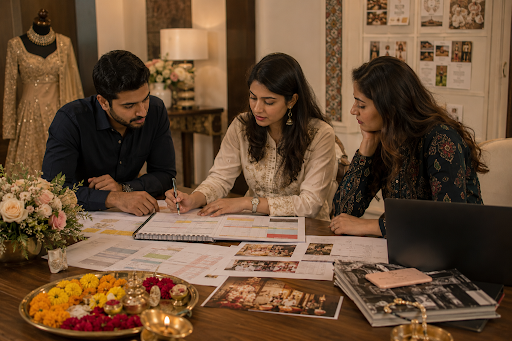
This is the most important document a coordinator will produce. It is the single source of truth
for every vendor, every family member, and every team member on the wedding day.
- Build a function-wise timeline: a separate detailed timeline for Haldi, Mehendi, Sangeet,
Wedding Day morning, ceremony, and reception
- Include vendor arrival times, setup windows, ceremony start times, meal service windows, and
event close time
- Add buffer time between every major transition — Indian weddings always run slightly behind
schedule
- Share this document with every vendor at least 2 weeks before the event
- Keep a printed copy with you at all times during the wedding week
Vendor Confirmation Round 1
Reconfirm every booked vendor via phone or in-person meeting.
- Verify the specific team members who will be working your event — key person cancellations
happen and you need to know immediately
- Confirm all final payments, pending balances, and preferred payment modes
- Collect emergency contact numbers for each vendor's on-site lead
Legal and Ritual Requirements
Confirm marriage registration requirements with the local municipal authority.
- Brief the pandit or officiant on the ceremony structure, any personalization, and the timing
constraints
- If a non-Hindu or inter-faith ceremony is involved, ensure all legal documentation is
prepared well in advance
- Arrange all puja samagri items on a master list and assign responsibility to a specific
family member or coordinator assistant
3 Weeks Before: The Pressure Test Phase
This is when the plan gets stress-tested. Everything feels like it is happening at once, and
that is completely normal.
Final Guest Count Confirmation
Chase all non-RSVP guests aggressively — caterers and venue need a firm number.
- Adjust catering counts upward by 5-8% to account for last-minute additions (a common Indian
wedding reality)
- Finalize the seating chart and share it with the venue team for table setup
Vendor Management
Distribute printed coordinator contact sheets to every single vendor.
- Make it explicitly clear: on the wedding day, all vendor communications go through the
coordinator — not through the couple or their parents
- Walk through the venue with your key vendors (decor team, caterer, DJ) together so everyone
understands the layout
Contingency Planning
This is something most checklists skip entirely. A professional coordinator always has a Plan B.
- Outdoor ceremony? Identify an indoor backup space and make sure it can be set up within 2
hours
- What is the contingency if the main caterer has a last-minute emergency? Identify a backup
caterer
- What happens if the main photographer gets ill? Does their contract specify a replacement
photographer of equal caliber?
- Brief a trusted family member as your on-ground assistant for each function — someone who
knows the plan and can relay information
1 Week Before: Final Locking Phase
Rehearsal and Ceremony Run-Through
Not every Indian wedding does a formal rehearsal, but a walkthrough is always valuable —
especially when there are complex processional sequences, multiple stages, or first-time
performers at the Sangeet.
- Walk through the ceremony sequence with the pandit and key family members
- Confirm the processional order for the baraat and the wedding entry
- Test all AV equipment: microphone levels, music cues, projector if used
- Brief the MC or anchor on the event flow, key names to announce, and any audience
participation segments
Emergency Kit Assembly
Every professional coordinator carries one. Yours should include:
- Sewing kit with safety pins in multiple sizes
- Stain remover wipes
- Blotting paper and setting spray for makeup touch-ups
- Pain relief tablets, antacids, and basic first aid
- Spare dupatta pins and brooch pins
- Phone chargers and a portable power bank
- Small scissors and double-sided tape
- A printed copy of the master vendor contact list
- Snacks and water for the bridal party (people forget to eat on wedding days)
Final Payments Preparation
Prepare sealed envelopes with vendor payments — organized by vendor name.
- Include a thank-you note in each envelope (small gesture, remembered for a long time)
- Have the payment list double-checked against contracts to ensure correct amounts
Wedding Day: Function-by-Function Coordination
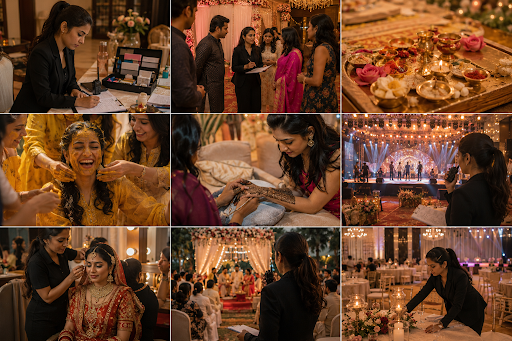
Morning — Haldi Ceremony
The Haldi is typically an intimate, chaotic, joyful event. The coordinator's role here is
light-touch but important.
- Ensure the Haldi setup (seating, backdrop, flowers, brass plates with Haldi mix) is complete
30 minutes before guests arrive
- Coordinate with the photographer — Haldi ceremonies are fast-moving and the key moments
happen quickly
- Have old towels and change of clothes ready for everyone likely to get Haldi on their
outfits
- Manage the timeline firmly — Haldi events have a tendency to run long and compress the
Mehendi that follows
Mehendi
Confirm the number of Mehendi artists and their assigned stations early in the morning.
- Create a priority queue: bride first, then close family and bridesmaids, then guests
- Ensure adequate seating, good lighting, and a chill but festive playlist
- Coordinate refreshments for guests who may be waiting for their turn
Sangeet
The Sangeet is often the most logistically complex of all pre-wedding functions.
- Confirm the running order of all performances with each performing group by early afternoon
- Brief the DJ or live musician on cue music for each performance and transition music between
acts
- Ensure the stage lighting is adjusted for performance mode well before the event starts
- Coordinate with the anchor on the script and timing for each segment
- Have a printed show order at the DJ and anchor stations
Wedding Day Morning: Bridal Suite Coordination
Build a detailed hair and makeup timeline working backward from the ceremony start time.
- Confirm vendor arrival times (hair stylist, makeup artist, mehendi artist for any touch-up)
- Keep the bridal suite calm and organized — too many people in a small space creates chaos
- Ensure the bridal outfit, jewelry, shoes, and all accessories are laid out and ready well in
advance
- Coordinate with the photographer for getting-ready shots without disrupting the actual
preparation
- Manage family members who want to be in the bridal suite — kindly but firmly control the
number
Ceremony: The Core Coordination
This is where precision matters most.
- Station yourself at the entrance 30 minutes before the ceremony is scheduled to begin
- Direct ushers on guest seating — VIP rows should be clearly identified
- Cue the baraat arrival coordination: music start, timing of the entry, where the groom
dismounts or stops for the Jaimala photo moment
- Signal the DJ or band for processional music when the bride is ready to walk
- Keep a close eye on the timeline — communicate with the pandit on pacing if the ceremony is
running too long
- Ensure the photographer has clear access to all key moments: Jaimala, Saat Phere, Sindoor,
and the final blessing
Reception: Managing the Celebration
Oversee table setup and confirm the seating chart is accurately placed before doors open.
- Coordinate with the catering team on the meal service start time relative to when the couple
arrives
- Brief the MC on the order of toasts, first dance, cake cutting, and any special announcement
- Manage the gift table and ensure gifts are secured and moved to a safe location
progressively during the event
- Coordinate transport for the couple and immediate family at the end of the night
- Handle any last-minute vendor tips distribution with your pre-prepared envelopes
Post-Wedding: The Wrap-Up Phase
Most checklists end at the reception. Professional coordination does not.
Immediate Next Day
- Ensure all rented decor items, equipment, and linens are returned to the respective vendors
- Do a final check of the venue for any left-behind personal items — jewelry, phones, shawls
- Collect any remaining payments and confirm receipt acknowledgment with vendors
Within One Week
- Follow up with the photographer and videographer on expected delivery timelines
- Assist the couple in filing for marriage registration if not already done
- Write thank-you messages to key vendors whose service was exceptional — this builds
professional relationships and reflects well on you
Within One Month
- Coordinate with the couple for any post-wedding photo selection for albums
- If you are a professional coordinator, schedule a brief feedback call with the couple to
review what went well and what could improve
- Update your vendor reference list based on this wedding's experience — who to recommend and
who to approach cautiously next time
The Hidden Costs Every Coordinator Needs to Flag Early

This section alone is worth saving this entire blog. Couples are consistently surprised by costs
that experienced coordinators see coming from a mile away.
- Venue overtime charges: If your event runs past the contracted time, most
venues charge per hour — often significantly. Build buffer into your timeline.
- Generator costs: Many venues charge separately for generator backup,
especially for full-day events with heavy lighting rigs.
- Decor setup labor: Some decor companies quote only materials. Labor for
installation and removal can be a substantial addition.
- Photography albums: A shooter's base package often includes digital files
only. Physical albums are priced separately and can add significantly to the total.
- Catering staffing for bar service: If you add a bar to a catering contract,
bartender staffing is frequently billed as an additional head.
- Late vendor delivery charges: If your caterer or decor team needs to arrive
at 6 AM for an 8 AM setup, early morning surcharges may apply.
- Pandit dakshina and samagri: Often not included in any formal quote and
left as a surprise expense on the day.
Red Flags to Watch for When Vetting Vendors
After coordinating hundreds of weddings, certain vendor behaviors consistently signal trouble
ahead.
- A vendor who is reluctant to provide a written contract should be approached with extreme
caution
- Unusually low quotes are almost always a sign that something is excluded — always ask what
is NOT included
- A photographer who cannot show you a complete wedding gallery (only highlights) may not have
the depth of coverage you expect
- A caterer who refuses a food tasting before contract signing is not a caterer worth booking
- A venue that is vague about its cancellation policy in writing is a venue that will not be
flexible if something goes wrong
Why a Professional Wedding Coordinator is Not a Luxury — It is Insurance
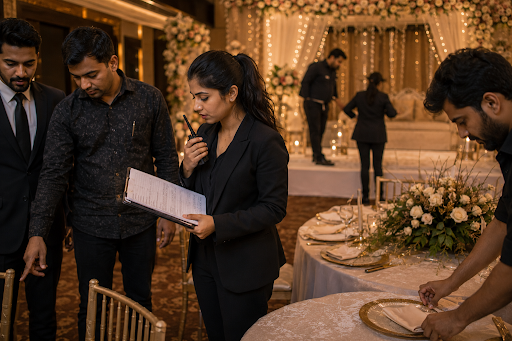
Many couples approach professional coordination as an optional add-on — a convenience for those
with large budgets. This is a fundamental misunderstanding of what coordination actually
delivers.
A professional coordinator does not just manage logistics. They anticipate problems before they
happen, navigate vendor conflicts without disturbing the couple's experience, enforce timelines
that protect the entire event flow, and absorb the stress that would otherwise land on the
family. They are the invisible infrastructure of a wedding day that feels effortless.
At Weddings and Events by Amitesh, we have stopped a caterer from serving the wrong menu,
renegotiated decor terms on-site when delivered florals did not match the contracted brief, and
quietly managed family disagreements that could have disrupted ceremonies — all without the
couple ever knowing there was a problem. That is what professional coordination looks like.
If you are planning your wedding and want it managed by a team that has truly seen everything —
contact Weddings and Events by Amitesh today. We would love to be part of your celebration.
A Quick-Reference Master Checklist Summary
12 Months Out
- Finalize budget across all contributing parties
- Build initial guest list
- Start venue research and visits
9 Months Out
- Book photographer and videographer
- Shortlist caterer and schedule tasting
- Book decor team
6 Months Out
- Order bridal outfits and wedding attire
- Dispatch invitations
- Block outstation guest accommodation
3 Months Out
- Build master event timeline
- Vendor confirmation Round 1
- Confirm all legal and ritual requirements
3 Weeks Out
- Final guest count confirmation
- Distribute vendor contact sheets
- Finalize seating chart
1 Week Out
- Conduct ceremony walkthrough or rehearsal
- Assemble coordinator emergency kit
- Prepare vendor payment envelopes
Wedding Day
- Arrive 60-90 minutes before the first event
- Manage every function from Haldi through reception
- Collect all gifts and personal items before venue exit
Post-Wedding
- Return all rentals
- Venue final check
- Follow up with photographers and key vendors
Weddings and Events by Amitesh is a full-service wedding planning and coordination company.
Whether you need end-to-end planning or day-of coordination, our team brings the experience, the
calm, and the expertise your celebration deserves. Reach out to us to begin planning.