×
![Popup Image]()


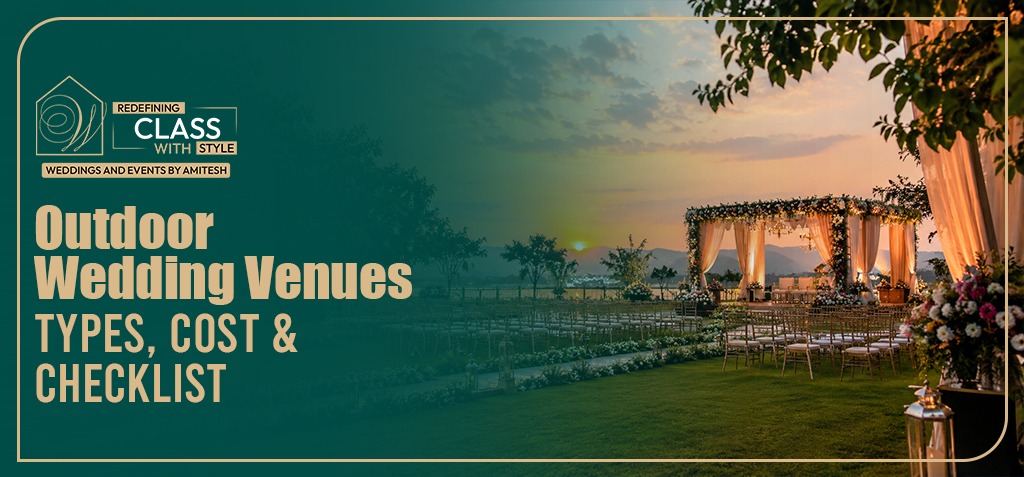
Almost every couple who loves the idea of an outdoor wedding starts with a photograph. A palace lawn at golden hour, a beach at sunset, a desert camp under a sky full of stars. The photograph is real. What it does not show is the generator behind the tree, the rain cover that stayed folded, the loudspeaker that had to switch off at ten, and the guests who spent the evening looking for a toilet.
Outdoor wedding venues are the most rewarding place to marry in India, and the least forgiving. An indoor hall absorbs your mistakes. A lawn exposes them. This guide is written to help you choose the right outdoor wedding venue with your eyes open: the ten kinds of outdoor venue, the months that work in each region, how much ground you really need, what outdoor adds to your bill, what to do about rain, heat, cold and sound, and a 100-point scorecard you can carry to every site visit.
We plan weddings across Rajasthan every season, so the examples lean on Jaipur, Udaipur, Jodhpur and Jaisalmer, but the method works anywhere in India. Where a number is ours, we say so. Where it comes from a source, we name it.
After enough weddings, the failures start to look the same. They are rarely about taste. They are about eight risks that nobody put on the budget sheet.
| Risk | What goes wrong | The fix, in one line |
|---|---|---|
| Weather | Rain, heat, cold or wind forces a change of plan on the day | Choose the right month, then buy a rain or cooling plan before you sign |
| Sound | Music has to stop at the legal cut-off | Put the loudest events before 10 PM, and keep a closed hall for later |
| Power | A single generator fails and the lights go out | Size the load, split it across circuits and keep a backup |
| Toilets and water | Queues, hygiene complaints and a very long evening | Add temporary toilets and plan one clean block per 40 guests |
| Access and parking | Cars block the road, and décor trucks cannot reach the lawn | Walk the route with a truck-sized mind and plan marshals |
| Layout | The lawn is too small once the stage and counters are placed | Do the space maths before you pay a token |
| Safety | Fireworks, bonfires and crowds without permission or first aid | Get permissions in writing and keep a medical plan |
| Contract | The venue promises a backup hall and then cannot deliver one | Write the backup into the contract with dates and capacities |
Not every outdoor venue behaves the same way. A palace lawn and a beach differ in almost every planning decision. This table lets you compare the main types before you fall for a photograph. The cost column is relative, from one rupee sign to four, and is our judgement across weddings we have planned, not a quote.
| Venue type | Where it works | Typical guests | Best months | Signature risk | Relative cost |
|---|---|---|---|---|---|
| Palace lawn or courtyard | Jaipur, Udaipur, Jodhpur and other Rajasthan cities | 100 to 500 | Oct to Mar | Heritage rules on décor, fire and noise | ₹₹₹ to ₹₹₹₹ |
| Hotel or resort lawn | Every large city and tourist town | 150 to 1,000 | Oct to Mar | Shared property and an 11 PM close | ₹₹ to ₹₹₹ |
| Farmhouse or farm resort | Outskirts of Jaipur, Delhi NCR, Pune, Bengaluru | 100 to 800 | Oct to Mar | Power, toilets and roads are your job | ₹₹ to ₹₹₹ |
| Lakeside or riverside | Udaipur, Rishikesh, Haridwar and river towns | 50 to 300 | Oct to Mar | Wind, water edges and limited space | ₹₹₹ to ₹₹₹₹ |
| Beach | Goa, Kerala, Konkan and the south-east coast | 50 to 300 | Nov to Feb | Tide, sand, humidity and permissions | ₹₹ to ₹₹₹ |
| Desert camp | Jaisalmer, Pushkar and Jodhpur outskirts | 50 to 300 | Nov to Feb | Cold nights, dust and distance | ₹₹ to ₹₹₹ |
| Forest and wildlife resort | Ranthambore, Jim Corbett and central India reserves | 50 to 200 | Oct to Mar | Wildlife rules, roads and early closing times | ₹₹ to ₹₹₹ |
| Hill station | Mussoorie, Shimla, Ooty and similar towns | 50 to 200 | Mar to Jun, Oct to Nov | Narrow roads, landslides and cold | ₹₹ to ₹₹₹ |
| Plantation or vineyard estate | Coorg, Wayanad, Nashik and similar belts | 50 to 250 | Nov to Feb | Distance and few backup halls | ₹₹ to ₹₹₹ |
| Fort rampart or terrace | Jodhpur, Jaisalmer, Chittorgarh and fort hotels | 50 to 250 | Oct to Mar | Heavy weight limits and wind | ₹₹₹ to ₹₹₹₹ |
A few things stand out. Palace and fort venues give you instant architecture, so décor can be lighter, but they ask for the most permissions. Farmhouses give you the most freedom and the most work, because you bring everything yourself. Beaches and deserts make photographs that nothing else matches, and they punish a weak rain, wind or cold plan. Forest and hill venues are the most beautiful and the hardest to reach, so guest transport becomes a major budget line.
If you want a longer list by city, read our guides to wedding venues in Jaipur and wedding venues in Udaipur, and our overview of a destination wedding in India, which compares regions side by side.
India has more climate than most continents, and the best outdoor month in one state is the worst in another. Use this table as a first filter. These are typical patterns from our experience, so check the forecast for your date with the India Meteorological Department, which publishes onset and advance of the monsoon.
| Region | Most reliable window | Watch out for | Normal monsoon onset |
|---|---|---|---|
| Rajasthan (Jaipur, Udaipur, Jodhpur) | Late Oct to Mar, best from mid-Nov to mid-Feb | Cold nights in December and January, heat from April to June | Udaipur about 25 Jun, Jaipur about 29 Jun |
| Jaisalmer and the western desert | Nov to Feb | Very cold nights, dust, long transfers | About 8 Jul |
| Delhi NCR, Punjab and Haryana | Oct to Mar | Winter fog that delays flights and cars | Delhi about 27 Jun |
| Mumbai, Konkan and Goa | Nov to Feb | Humidity, sudden showers outside winter | Mumbai about 11 Jun |
| Kerala | Dec to Mar | Heavy rain from late May | About 1 Jun |
| Uttarakhand and the Himalayan foothills | Mar to May, Oct to Nov | Landslides, road closures and cold | Dehradun and Mussoorie about 20 Jun |
| South interior (Bengaluru, Hyderabad, Mysuru) | Nov to Feb | Rain can arrive outside the main monsoon | Varies |
The dates in the last column are IMD normals for the onset of the south-west monsoon, from IMD's revised study of 1961 to 2019 data. They are averages. In any year the rain can arrive a week early or late, and pre-monsoon showers can come before. The IMD also notes that the monsoon normally sets in over Kerala around 1 June and covers the entire country by about 8 to 15 July depending on which normal you use. In practice, treat late June to mid-September as a rain-risk window for most of the country, and mid-September to October as the tail.
| Months | Season | Weather in Jaipur | Price effect (our contracts) | For an outdoor wedding |
|---|---|---|---|---|
| 15 Nov to 15 Feb | Peak | 8–22°C | 1.3x to 1.5x | Best weather. Needs heaters after sunset. Book 12 to 18 months ahead. |
| Oct and 1 to 15 Mar | Shoulder | 18–30°C | 1.0x to 1.15x | The sweet spot: pleasant evenings and lower prices. |
| Apr to Jun | Off-peak | 28–42°C | 0.7x to 0.85x | Only after sunset, with cooling and a closed hall. |
| Jul to Sep | Monsoon | Humid with rain | 0.6x to 0.8x | Outdoor only with a strong waterproof structure. |
Muhurat dates add their own pressure. Wedding dates restart after Dev Uthani Ekadashi in the second half of November, and many families chase the same few dates in December, so ask your pandit for two or three options. Our guide to the best month for a Jaipur wedding goes through each month in detail.
An outdoor ceremony lives or dies by light. The sun sets earlier than most families expect in winter, so a 5 PM ceremony in December already needs lights. These are approximate sunset times for Jaipur through the year. Other cities shift by 15 to 40 minutes.
| Month | Approx. sunset | Golden hour starts | Planning note |
|---|---|---|---|
| December | 5:30 PM | 4:45 PM | Light fades fast. Have lighting live by 5 PM. |
| January | 5:50 PM | 5:05 PM | A 4:45 PM ceremony catches the best light. |
| February | 6:15 PM | 5:30 PM | Comfortable evenings. The best month for lawns. |
| March | 6:30 PM | 5:45 PM | Warming. Keep the shade ready until 5 PM. |
| April | 6:50 PM | 6:05 PM | Hot until sunset. Start functions late. |
| June | 7:20 PM | 6:35 PM | Late dusk, but the heat lingers. |
| September | 6:25 PM | 5:40 PM | Rain risk is the main concern. |
| October | 5:55 PM | 5:10 PM | Pleasant, with the first cool evenings. |
| November | 5:25 PM | 4:40 PM | Early dusk. Plan the baraat around it. |
Photographers love the 45 minutes before sunset because the light is soft and warm. Put the mandap on the side of the lawn where the sun is behind the guests, not in their eyes, and your photographs will be better than anything a filter can fix. Our photography and videography team walks the lawn at that hour before the date, and you should too.
This is the single most common planning error. People look at an acre of lawn and think it is huge. Then the stage, the dance floor, the food counters and the walkways go in, and it is full. Here is the method we use.
Start with the seated dinner. Round tables of ten, with aisles for service, need about 14 sq ft per guest. A standing cocktail needs about 6 to 8. Then add the fixed zones: a stage, a dance floor, one food counter for every 55 guests at about 90 sq ft each, an entry and photo area, and a bar. Finally add 15 percent for walkways and circulation. Here is what that looks like at three sizes.
| Zone | 200 guests | 400 guests | 800 guests |
|---|---|---|---|
| Seated dinner at 14 sq ft per guest | 2,800 sq ft | 5,600 sq ft | 11,200 sq ft |
| Stage and mandap | 500 sq ft | 600 sq ft | 800 sq ft |
| Dance floor | 400 sq ft | 700 sq ft | 1,200 sq ft |
| Food counters (4 / 8 / 15) | 360 sq ft | 720 sq ft | 1,350 sq ft |
| Entry, photo area and bar | 600 sq ft | 800 sq ft | 1,200 sq ft |
| Walkways and circulation (15%) | 700 sq ft | 1,300 sq ft | 2,400 sq ft |
| Total lawn needed | 5,400 sq ft | 9,700 sq ft | 18,100 sq ft |
Test this against real venues. A hotel in Mansarovar lists a lawn of 25,000 sq ft with 750 seated and 1,500 floating. By our method, 750 seated guests need about 17,200 sq ft, so the listing is plausible. A venue that claims 5,000 guests on a 20,000 sq ft lawn is counting people standing shoulder to shoulder, which is not a wedding. When a venue gives you only one number, ask for the lawn area in square feet and do this sum yourself.
Two more points on space. Slope matters, because a gentle slope helps drainage and a steep one makes tables wobble. And shade matters, because a lawn with trees along one edge gives you a natural dining zone and a cooler afternoon.
Outdoor weddings are not cheaper by default. A lawn is free of walls, ceilings and air conditioning, and a hotel hall comes with all three. When you take the building away, you rent each of its jobs back by the day. Here is the "outdoor premium" for a wedding of about 400 guests, with ranges from our own planning. Use it as a checklist, then replace each line with a real quote.
| Outdoor-only cost | Range | What it is for |
|---|---|---|
| Power backup and distribution | ₹2–6 L | Generator, cabling and fuel for lights, sound and counters |
| Extra lighting for a lawn | ₹2–6 L | A lawn has no ceiling or walls, so every light is rented |
| Flooring and ground cover | ₹0.5–2 L | Carpet, matting or deck over grass and uneven ground |
| Temporary toilets and wash areas | ₹0.3–1.5 L | Cabins, hand-wash points and a cleaning crew |
| Cooling or heating | ₹0.5–3 L | Misting fans and coolers in summer, heaters and bonfires in winter |
| Pest control and fogging | ₹0.1–0.3 L | Mosquitoes and insects around lights and food |
| Security, parking staff and crowd control | ₹1–3 L | Open grounds need more people on the gates |
| Rain cover (only the part you need) | ₹1.5–16 L | Waterproof structure over the mandap or the dining area. A full-lawn cover costs more. |
| Total without a large rain cover | ₹6.4–21.8 L | |
| Total with a rain cover | ₹7.9–37.8 L |
Put that next to the venue's own prices. Our contracts show that a 4-star hotel wedding for 300 or more guests runs about ₹90 lakh to ₹1.3 crore for two days, before GST, so the outdoor premium is roughly 5 to 25 percent of the bill without a big rain cover, and more with one. The number is not a reason to avoid an outdoor venue. It is a reason to ask any venue that quotes "lawn included" what is actually included.
For the wider cost picture, including rooms, food and décor by guest count, see our destination wedding cost in Jaipur guide. If you are comparing by guest count, the wedding budget page shows examples at 100, 200 and 500 guests, and our Jaipur wedding packages page shows what each plan includes.
Food is usually the largest line, and outdoor venues price it very differently from hotels. These ranges come from contracts we have negotiated in Jaipur, before 18% GST and 10% service charge.
| Venue type | Veg dinner per plate | Non-veg dinner per plate | Room block per night |
|---|---|---|---|
| Banquet and lawn venues | ₹800–1,200 | ₹1,000–1,500 | ₹3,000–6,000 |
| Heritage havelis | ₹1,200–2,000 | ₹1,500–2,500 | ₹5,000–12,000 |
| 4-star hotels | ₹1,800–2,500 | ₹2,200–3,000 | ₹6,500–15,000 |
| 5-star hotels | ₹2,500–4,000 | ₹3,000–5,000 | ₹9,000–25,000 |
| Premium palaces | ₹4,000–6,000 | ₹5,000–7,000 | ₹15,000–40,000 |
Two small points affect the final plate cost outdoors. Outside caterers need a temporary kitchen area, water and a screened food-prep zone, and some venues charge for it. And large lawns need more serving staff per guest, because the food travels farther from the kitchen. Ask for both numbers. If you want a caterer who handles open-air kitchens, our wedding catering services team can talk you through a layout.
Everyone says "have a rain plan". Few people can tell you what one is. In practice, a rain plan is a decision about which part of the wedding you must keep dry, a structure that keeps it dry, and a deadline for deciding.
Use the 400-guest layout from earlier: about 9,700 sq ft for the whole lawn, about 6,300 sq ft for the dining and counters, and about 1,800 sq ft for a mandap and the family seating. A rented waterproof structure with flooring and drainage, in our planning range of ₹80 to ₹250 per sq ft depending on type, gives these approximate costs. Quotes vary widely, so ask three vendors.
| Option | Area covered | Planning cost | Best for |
|---|---|---|---|
| Cover the mandap and family seating only | 1,800 sq ft | ₹1.4–4.5 L | A short ceremony with an indoor dinner as the backup |
| Cover the dining and counters | 6,300 sq ft | ₹5–15.8 L | Weddings where the dinner is the main event |
| Cover the whole lawn | 9,700 sq ft | ₹7.8–24.3 L | Monsoon weddings, or any date with a high rain risk |
| A backup hall booked in the contract | The hall's capacity | Part of the venue price | Weddings under 200 guests, or a split dinner |
A backup hall is the cheapest cover, but only if it holds enough. A rule we use: the backup must seat at least your pheras group (family and close guests, often 100 to 150 people) and the dinner in two sittings. If the hall holds 400 and you have invited 900, a hall alone is not a rain plan. Ask the venue for the hall's seated and floating capacity in writing, and ask whether another event is booked in it on your date.
| When | Decision | Who decides |
|---|---|---|
| 7 days before | Check the forecast. If the rain risk is high, confirm the cover vendor and the hall hold. | Planner and the host family |
| 3 days before | Re-check. Move the structure on site if the forecast stays high. | Planner and the décor vendor |
| 24 hours before | Final go or no-go for the lawn, the hall or the covered option. | The host family and the planner |
| 6 hours before | Last check with the venue. Tell the vendors and the band. | The planner |
The most important line in that table is the last column. Name one person who makes the call, and agree it before the stress starts. We have seen weddings wait for the "right" moment and lose a whole evening. For a real example of how a plan like this plays out, read our story of an outdoor wedding saved from the rain.
Rain is the weather problem everyone plans for. These five cause more quiet discomfort at real weddings.
| Condition | Where it bites | What works | Planning cost |
|---|---|---|---|
| Heat | Rajasthan, Delhi NCR and the plains from April to June | Start after sunset, add shade, misting fans, coolers and water stations. Keep an air-conditioned room for elders. | ₹0.5–3 L |
| Cold | Rajasthan, Delhi NCR, hills and desert from December to February | Patio heaters, bonfire pits, shawls or blankets, tent walls and hot drink counters. | ₹0.3–1.5 L |
| Wind | Beaches, rooftops, lakesides and desert | Weighted structures, no tall free-standing décor, secured drapes and anchored lighting. | Built into the structure |
| Dust | Desert and dry-belt lawns | Water the ground the morning of the event, use ground cover and cover the food. | ₹0.1–0.5 L |
| Insects | Lawns near water, gardens and farmhouses | Fogging before the event, citronella, and keep lights away from food counters. | ₹0.1–0.3 L |
Winter nights deserve special mention in north India. A lawn that is perfect at 5 PM can be cold by 8 PM, and the bride's outfit is rarely warm. Plan for it by putting the pheras on the sunlit side early, keeping a heated area for the family and thinking about hot chai and kahwa counters as part of the menu, not as an afterthought.
India's Noise Pollution (Regulation and Control) Rules, 2000 restrict the use of loudspeakers and public address systems between 10 PM and 6 AM, except in closed premises such as auditoria, conference rooms, community halls and banquet halls. States can allow a limited number of festival nights up to midnight in the year. A short summary is on SCC Online.
This is why so many outdoor venues in India set a 10 PM or 11 PM close and say "no late music". It is not the venue being difficult. It is the law, and a police complaint from a neighbour ends your night. Plan for it from day one.
Rules differ by state and district, so confirm each with the venue and your planner. Apply early, because some take days.
| Permission | Usually needed for | Who normally arranges it |
|---|---|---|
| Excise permission | Serving alcohol at a function | The venue or your bar vendor, on your behalf |
| Loudspeaker or sound permission | Outdoor music and any late-evening exception | The venue, planner or local police |
| Fire and fireworks permission | Fireworks, cold pyro and bonfires | The vendor and the local fire or police office |
| Baraat on a public road | A procession with a band, horse or vehicles | The family or planner, with local police intimation |
| Drone permission | Aerial shots and drone shows | The photographer or drone operator |
| Food licence | Any caterer serving the guests | The caterer, which should show a valid licence |
| Temporary structure safety | Large tents, stages and heavy lighting rigs | The vendor and the venue |
These are the parts guests never compliment and always notice when they fail.
A lawn has none of the lighting, cooling or sound that a hall comes with, so every item draws power from a generator or the venue's supply. List the loads: stage and mandap lighting, uplights and string lights, the sound system, food counters and chillers, cooling or heating, and the bar. Then ask a licensed electrician to size the supply and split it across circuits, so a single trip does not black out the whole lawn. Our contracts show power backup costs ₹2 to ₹6 lakh for a large wedding. Ask who owns the fuel, who refuels during the event, and where the generator sits, because its noise and exhaust should be away from the dining zone.
Our planning rule is about one toilet seat for every 40 guests, with separate blocks for women and men and one accessible unit, and more if the bar is open. Add hand-wash points, a cleaning crew during the event and a sign that is visible in the dark. Check where the venue's own toilets are and how many guests can reach them without crossing the dining area.
Outdoor lighting is not just décor. It is safety, photography and mood. Light the path from parking to the lawn, the steps, the toilets and the bar. Then decide the story: warm string lights and lanterns for a garden, uplighting on the trees for a palace, soft candles on tables for a beach. Our real wedding stories show lighting choices in different settings, and the our work page shows finished lawns.
A lawn is rarely flat, and heels sink into grass. Plan walkways of matting, a firm dance floor and a pathway for the bride. Check the slope for table stability. And keep an eye on irrigation lines, because a sprinkler head popping up mid-dinner is a story nobody wants.
Carry this to every site visit. Score each line honestly, add them up and compare venues on the same sheet. It turns a heart decision into one you can defend to your family.
| Category | Points | What to look for |
|---|---|---|
| Weather resilience | 20 | Right month for the region, a verified rain plan, shade, wind cover and a heat or cold plan |
| Space and layout | 15 | Enough area for your guest count and zones, a good slope, and a clear flow from entry to dinner |
| Power and utilities | 10 | Reliable supply, backup, fuel plan, water and drainage |
| Sound and timing rules | 10 | A written cut-off, a closed hall for late music and no neighbour risk |
| Access and parking | 10 | Road for décor trucks, enough parking, a baraat route and an emergency exit |
| Guest comfort | 10 | Toilets, seating, shade, lighting and a quiet area for elders |
| Safety and permissions | 10 | First aid, fire safety, written permissions and a medical plan |
| Backup space | 10 | A hall or covered area of enough capacity, written into the contract |
| Value and contract | 5 | Clear pricing, flexible vendors, and fair deposit and cancellation terms |
How to read your score. Above 80: a strong venue, so negotiate the details. Between 65 and 79: workable, but fix the weakest category in writing before you pay. Below 65: walk away, however good the photographs look. A venue can score 18 out of 20 on weather and 2 out of 10 on backup space, and that single gap is the one that ends up in your wedding story.
Visit twice if you can: once in daylight and once at the hour your wedding will happen. Take a tape measure, a phone with signal bars and someone who has done this before.
A good contract protects you from the things the brochure never mentions. Ask for these in plain words.
| Clause | Why it matters |
|---|---|
| Backup space | Names the hall or cover, its capacity and the dates it is held for you. |
| Exclusive use | Confirms no other event or guests use the lawn or the hall on your dates. |
| Sound cut-off | States the end time and what happens after it. |
| Power and fuel | Says who provides the generator and who pays for fuel. |
| Vendor access | Sets the entry fee, deposits and the time décor teams can enter. |
| Weather and force majeure | Explains what is refunded or moved if the weather or an official order stops the event. |
| Damage and cleanup | Names the deposit and the standard for returning the lawn. |
| Payment and cancellation | Spells out the schedule, the refund terms and the date-change policy. |
Rajasthan is where most of India's palace lawns, desert camps and fort terraces are. The government has also been pushing "Wed in India" as a theme, and the Ministry of Tourism has run a campaign to position the country as a premier wedding destination, as described in this Press Information Bureau release. Here is how Rajasthan's outdoor options break down.
We have mapped several Jaipur venues with a lawn, a rooftop or both. These are the figures we found, and where each comes from. They are listings or the hotels' own pages, so confirm them with the venue.
| Venue | Outdoor space | Capacity signal | Cost signal | Good for |
|---|---|---|---|---|
| Samskara Resort (farm resort) | Banquet Lawn, 2+ acres, with an orchard setting | Up to 800 guests | ₹17.5 lakh + GST buyout, room only | A private, green weekend wedding |
| Anant Mahal (new palace-style hotel) | Lawn Vatika, 25,000 sq ft | 750 seated, 1,500 floating (listing) | Listed ₹4,999 room and ₹2,000 veg plate | A palace look with many rooms |
| Jaipur Vilas Resort (lawn venue) | A large lawn and an AC hall, no rooms | 1,500 seated, 2,500 maximum (listing) | Listed veg plate ₹900 | A very large guest list |
| Laxmi Palace (boutique hotel) | Rooftop and pool deck | 50 to 70 guests per space | Rooms from ₹2,999 on the hotel site | An intimate old-city wedding |
For the full numbers, read our guides to the Samskara Resort Jaipur wedding cost, the Anant Mahal Jaipur wedding cost and the Jaipur Vilas Resort wedding cost.
For a heritage backdrop, Jaipur has several palace and hotel properties with lawns and courtyards. Our contracts put a two-day wedding at the Chomu Palace at roughly ₹60 lakh to ₹1.2 crore, and at Fairmont Jaipur at roughly ₹70 lakh to ₹1.5 crore. You can also read how we plan at Rambagh Palace, Samode Palace ,ITC Rajputana and Jai Mahal Palace. For a side-by-side view, the palace wedding venues comparison lines them up by style and size.
| Destination | Outdoor character | Best months | Read more |
|---|---|---|---|
| Udaipur | Lakeside terraces and palace courtyards | Oct to Mar | Wedding planners in Udaipur |
| Jodhpur | Fort ramparts and blue-city rooftops | Oct to Mar | Wedding planners in Jodhpur |
| Jaisalmer | Desert camps under open skies | Nov to Feb | Wedding planners in Jaisalmer |
| Ranthambore | Forest resorts near the tiger reserve | Oct to Mar | Wedding planners in Ranthambore |
| Jim Corbett (Uttarakhand) | River and forest resorts | Mar to May, Oct to Nov | Wedding planners in Jim Corbett |
Jim Corbett sits in Uttarakhand, which has its own rules for permissions, so a venue in another state needs its own checks. Our guide to types of weddings we plan shows how rituals fit different settings.
Not every couple wants a destination. Many want an outdoor wedding in or near their own city. The method is the same, with shorter drives.
| When | What to do |
|---|---|
| 12 to 18 months before | Pick the region and month. Shortlist venues. Visit in daylight and at the event hour. Score each venue. |
| 9 to 12 months before | Sign the contract with the backup space, sound and power clauses. Book the planner, décor and photographer. |
| 6 to 9 months before | Plan the layout with measurements. Book entertainment around the sound cut-off. Draft the rain, heat or cold plan. |
| 3 to 6 months before | Menu tasting. Request quotes for a rain cover. Apply for permissions. |
| 1 to 3 months before | Finalise the layout drawing, the lighting plan and the guest comfort plan. Confirm toilets, parking and security. |
| 1 week before | Check the forecast. Confirm the cover vendor, the hall hold and the person who makes the weather call. |
| Wedding week | Walk the lawn at the event hour. Test the power. Brief marshals and drivers. |
| The myth | The fact |
|---|---|
| Outdoor weddings are always cheaper than hotel halls. | A lawn has no walls, ceiling, cooling or lighting, so you rent each one. The outdoor premium is real. |
| A bigger lawn is always better. | A lawn that is too big makes the wedding feel empty. Match the area to the guest count with the space table. |
| Rain only matters in the monsoon. | Pre-monsoon and post-monsoon showers can come in the weeks around it, so check the forecast for your date. |
| A tent is a rain plan. | A rain plan is a structure, a decision timeline and a named decision-maker. |
| The venue handles the sound law. | The law applies to your music. Your artists need the cut-off in writing. |
| You can decide on the day. | Outdoor decisions need a deadline the week before, not an hour before. |
Outdoor weddings multiply the number of moving parts: power, structures, toilets, permissions, sound, weather and guest comfort. A good planner earns their fee in the first site visit by spotting the lawn slope, the generator problem or the missing hall. That is the job of a destination wedding planner in Jaipur, and it is the work we have done for more than 12 years. If you are marrying from abroad, our page on NRI wedding planning explains how we run it over video calls, and our pre-wedding shoot in Jaipur guide shows locations that work in the same light.
If you want us to review your shortlist of outdoor venues, call or WhatsApp +91-9289184507 with the guest count, the dates and the cities, and we will send a scorecard and a cost estimate within 48 hours. You can also write to us through our enquiry page or the contact page.
The best outdoor wedding venues depend on your month and region. Palace lawns in Jaipur, Udaipur and Jodhpur suit October to March. Beaches in Goa and Kerala suit November to February. Desert camps in Jaisalmer suit November to February. Forest and hill venues suit March to May and October to November. Choose the type that fits your date first, then the property.
The main types are palace lawns and courtyards, hotel and resort lawns, farmhouses, lakeside and riverside venues, beaches, desert camps, forest and wildlife resorts, hill stations, plantation or vineyard estates and fort ramparts or terraces.
It ranges widely. Plate rates run from about ₹800 to ₹1,200 at banquet lawns to ₹4,000 to ₹6,000 at premium palaces. A two-day wedding for 200 guests at a 4-star hotel runs about ₹70 to ₹94 lakh before GST in our Jaipur contracts. The outdoor premium for power, lighting, toilets, cooling and security adds roughly ₹6.4 to ₹21.8 lakh for a 400-guest wedding, before a large rain cover.
For most of north India, mid-November to mid-February is the best, and October and early March are good value. For the west coast and Goa, November to February. For Kerala, December to March. For the Himalayan foothills, March to May and October to November.
Plan about 14 sq ft per seated guest, then add a stage, a dance floor, food counters at about 90 sq ft each, an entry and bar, and 15 percent for walkways. A 400-guest seated wedding needs about 9,700 sq ft.
Yes. Plan a structure that keeps the key part dry, a backup hall of enough capacity, a decision timeline and a named decision-maker. In most of north India the monsoon normally arrives in late June, and in Mumbai around 11 June, according to IMD normals.
Yes. India's noise rules restrict loudspeakers between 10 PM and 6 AM, except in closed premises such as banquet halls. States can allow a limited number of festival nights up to midnight. Plan the loudest events early and ask about an enclosed hall.
Not by default. A hall includes walls, a ceiling, cooling and lighting. A lawn needs each of them rented. An outdoor venue can still be cheaper if its plate rate and rental are lower, so compare the full bill.
Set a 60 to 90 minute travel radius, search maps for lawn, garden, farmhouse and resort in your area, shortlist five, make one call to each with seven questions, visit the best three at the event hour and score them out of 100.
Jaipur has palace and 5-star hotel lawns, resort and farm lawns, and rooftop venues. Examples we have researched include a farm resort lawn for up to 800, a hotel lawn of 25,000 sq ft, a large lawn venue for 1,500 seated and a boutique rooftop for 50 to 70 guests. See our wedding venues in Jaipur guide for more.
Commonly, excise permission for alcohol, sound permission, fire permission for fireworks and bonfires, police intimation for a baraat on the road, drone permission and a valid food licence for the caterer. Rules differ by state and district, so confirm with the venue.
Our planning rule is about one toilet seat for every 40 guests, with separate blocks for women and men and an accessible unit. Add more if a bar is open, and a cleaning crew for the evening.
It should seat at least your pheras group, often 100 to 150 people, and the dinner in two sittings. A hall for 400 does not cover a 900-guest wedding.
Yes, but only after sunset, with cooling, shade, water stations and an air-conditioned room for elders. In Rajasthan, April to June is hot, so many couples choose October to March instead.
It is possible with a strong waterproof structure over the whole area and a clear decision timeline. Prices are lower, at about 0.6x to 0.8x of peak in our contracts, but the risk is higher.
For peak dates between mid-November and mid-February, book 12 to 18 months ahead. For shoulder months, 8 to 12 months. Good outdoor venues book up early because they have fewer dates than hotels.
For a seated dinner with a stage, dance floor and counters, about 7,900 sq ft of usable lawn, and more if you want a larger dance area. Ask the venue for the area in square feet.
Ask about the lawn area, seated capacity, the backup hall, the music cut-off, power and fuel, toilets, parking, outside vendors, exclusive use and the cancellation policy. Our site-visit checklist and 100-point scorecard cover all of these.
They benefit more than indoor ones because of the extra moving parts: power, structures, permissions, sound and weather. A planner who knows outdoor venues spots the weak points on the first site visit.
Yes. Palace lawns, beaches, desert camps and forest resorts are the classic settings for destination weddings in India. Pick the one that fits your month, your guest count and your budget.
Choose the venue type that fits your month and region, do the space maths, budget the outdoor premium, buy a rain plan with a named decision-maker, design the evening around the 10 PM sound rule and score every venue out of 100 before you sign. An outdoor wedding is not harder than an indoor one. It simply asks you to plan the things a building would have planned for you.
Planning an outdoor wedding in Rajasthan or elsewhere in India? Send us your guest count, dates and shortlist on WhatsApp at +91-9289184507 and we will review it with you.
Monsoon normal dates come from IMD's revised study of onset and withdrawal, using 1961 to 2019 data. The loudspeaker rule comes from India's Noise Pollution (Regulation and Control) Rules, 2000, as summarised by SCC Online. The campaign reference comes from a Press Information Bureau release. Venue capacities, plate rates and room rates for the Jaipur venues come from each hotel's own site and the venue portals that list them. Jaipur plate, room and total costs come from contracts our team has negotiated. The space method, the outdoor premium ranges, the rain-cover costs, the toilet rule and the sunset times are our own planning figures. Everything can change, so confirm with each venue and vendor before you pay.